Sunday, 7 October 2012

A visit to the National Dinosaur Museum

Just realised that I hadn't put up a post about my recent visit to the National Dinosaur Museum. This is a privately owned and run museum on the outskirts of Canberra, Australia. I had visited before, a long time ago, and all I could remember was a heap of animatronic dinosaurs. Happily there are many other things there than just big roaring replicas. Before writing this post I looked up the address on Google and read some of the reviews that people had left. They were quite negative and many people had rated it 0/3 which I personally think is a bit rough. The museum is not large, and despite being called 'national' it comes across more like someones labor of love than what most of us would consider a 'national museum'. That aside, I still had a very enjoyable morning going around the exhibits, got lots of great photos, had a chance to eyeball some nice bone replicas and check out the fossils on display. The one thing I will pick on is the spelling in some of the exhibit text. I am a self confessed grammar and spelling pedant, but lets face it, it isn't that difficult to spellcheck or proof read something before it becomes part of a display, this really detracts from the museum. If you are going to play at being a serious museum, then at least make it look professional and not like a school project. Ok, rant over.

The museum takes you on a journey, around the edges of a large room, through time. It depicts ideas on how the earth was created and then moves into the beginnings of life. Each geological era and period has a section, describing what the earth was like at that time, what sort of life existed, both plant and animal, including mass extinctions. As it moves into the Paleozoic and Mesozoic, and the expansion of archeosaurs, then pelacosaurs and dinosaurs, the exhibits have some larger replicas and specimens on display. A large sauropod vertebra and several humerus bones, not to mention a lovely replica of an ichthyosaur fossil and a rather beautiful (if you like that sort of thing) Velociraptor skull. There are also some fully articulated casts on display. A Stegosaur, a Plateosaurus, an Allosaur, a Ceratopsian and a few others. I also really loved the family tree posters around the museum, particularly the 'mammal-like reptiles' one. Not sure who produced them but wouldn't mind getting my mits on the whole series. The last part of the display deals with the evolution of hominids, and there is a cabinet containing a series of hominid skulls.

They also have a gift store that is packed with Dinosaur related items. I was very tempted by a Deinonychus claw fridge magnet, and they had 50% off skulls, but I found it a bit hard to justify the price of these even discounted (yes, I am a cheapskate). There were a few fossils for sale, but I prefer collecting my own to buying others specimens, so I passed these by also.

Naturally I took lots of pictures:

Skull of the Sauropod Camarosaurus

Skull of the Ceratopsian Anchiceratops

Deinonychus foot

Hominid Skulls

Representation of the Aussie Dino Leaellynasaurus


It's a shame this poster came out blurry, it's a ripper

Sauropod Dystylosaurus Vertebra

Palaeo-art of T-Rex

Skull of Velociraptor mongoliensis

Allosaur skull
A Stegosaur Thagomizer
The Ichthyosaur Stenopterygius
Appears I have a bit of thing for skulls, well I guess this is the business end of most Dinosaurs! So as you can see, not just Dinosaurs, plenty of other prehistoric critters. Considering this is all privately run I think it's pretty good, and worth a visit for all Dino-enthusiasts.

Ostracodes- or, That funny little thing that looked like a bean

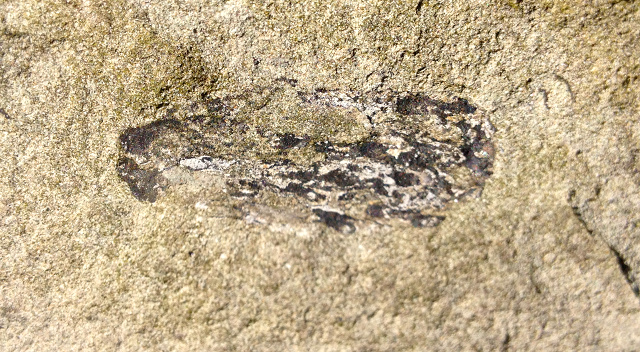
In the area I found the plant fossils on the Central Coast I also discovered a bean. Well, I thought it was a bean... then I realised it had what looked like legs, which struck me as odd, because as far as I knew, beans don't have legs. I consulted my trusty 'Introduction to Paleobiology and the Fossil Record' and Google, and discovered it was an Ostracode!

So what exactly is an Ostracod? Ostracodes are a type of crustacean arthropod, that is an armoured, (mostly) water dwelling, shell covered, animal. They are also known as 'seed shrimp' (obviously I'm not the first person to mistake one for a bean). They have two small shells that hinge along the back, think pipi, and the animal is contained within the two shells. They first appear in the Early Cambrian, about ~600Ma, and different types become more prolific at different times, some survived to the present day. Which makes them pretty remarkable in my books. They can be quite useful in reconstructing the environment of the stratigraphy in which they are found. There are even Ostracodes that bioluminesce.

I also did some reading at the Australian Museum, in a large tome titled 'Fossil Invertebrates' which outlined six main different types of Ostracode. I was hoping that the descriptions might help identify the little bean I found, but it could come from a number of orders. Here are some pictures of the little critter. In the picture that includes my stubby fingers you can see the appendages poking out from between to two shells, with a better contrasted close up second from the bottom!


Wednesday, 3 October 2012

Budgewoi Birding

We have more or less settled into the new house, so Bella and I decided to go birding this morning. In total we counted 19 different species and I saw two lots of birds in flight over the lake that I wasn't quick enough to identify. Fairly sure one was a Tern, the other probably a Masked Lapwing.
The birds were feeling very friendly today and I managed to get some photos. Here are the best of the bunch!

First spot of the day was a pair of Spotted Doves, which are introduced but look rather lovely.


Up one of the gum trees was a young Australian Magpie, who was incredibly curious, especially after I whistled something to him in what was meant to be Magpie warbling but sounded more like a dysfunctional slide whistle.


The awful noise also attracted some curious Little Corellas;


After we'd been thoroughly inspected by the magpie-corella-brigade we moved off down towards Budgewoi Lake.


There were several groups of Chestnut Teal along the lake edge. (Or as comedian Bill Bailey calls them "the ducks of evil", probably due to the red eye!)

Also spotted from near a small jetty was a fishing cormorant (sp. unidentified), an Australian Pelican, some beautiful Black Swans (lots of these):


An Eastern Great Egret and an Intermediate Egret (yes, I am sure it was the two different ones) pics in order...


Another long-legged wader was out fishing,


a White-faced Heron, who did quite well for little fish while we were watching.

On the other side of the path is a reserve, filled with Casurina, Paper-barks, Eucalypts and Palms. Water birds are replaced by parrots, Noisy Miners and Grey Butcherbirds. I also spotted this neat little nest:


The spectacularly colourful Eastern Rosella stopped to pose for the camera:


While a Galah waddled through the dandelions:


Oddly, the birds seemed to get more active the warmer it got! Perhaps they were using the shelter of the reserve to keep cool? I am currently on the look out for the Channel Billed Cuckoo, which makes a loud grating squawky noise and has a long curved beak. 

I have a number of blog posts in the works, so keep your eyes peeled for more Birds, Dinosaurs and Anatomy!

Sunday, 16 September 2012

A lighter side to evolution

My loving husband has kindly shared his 'flu with me. So instead of writing an inspiring and educational blog post, I give you the cartoon depictions of evolution from the point of view of birds, followed by the mammals. These came from the ScienceIsSeriouslyAwesome facebook feed.


Monday, 10 September 2012

I'd be the one with hummus...

Fossils from the Central Coast

As promised, here are some of the photos I took of fossils from a location on the Central Coast. If any of you out there in internet land recognise any of them please let me know. I am trying to get a reasonable date on them, and so far think they are from towards the bottom of the Narabeen sandstone. I have no idea if all the rock comes from the same locality as they are not in-situ. Apologies for not having a scale in the photos, I found the fossils while out walking and had nothing but my phone and dog with me!


Saturday, 8 September 2012

Back to the coast!

I have had a rather large gap between posts, this was due to the fact I was relocating from Bundanoon to reunite with my husband and trusty dog companion. We are living in what is affectionately known as 'Barkingham Palace' (badoom tish!). Which is located in Toukley, on the Central Coast of NSW. Oddly, our back garden looks almost identical to the one we had while living in Cairns, which pleases me because it makes it feel more like home.

Sadly the bird life visiting our garden has consisted mostly of Noisy miners Manorina melanocephala. These are a medium sized, grey, honeyeater, and while they are native can be a real pest due to their aggressive habit of attacking and driving off any other birds in 'their' territory. Having said that I have seen plenty of Rainbow Lorikeets, Magpies and Galahs. The best way to minimise Noisy miners in your area is to have a garden that contains a good understory, they hate understory and love lawns. If we owned the property I would certainly be addressing this, but for now we will just have to make do!

Having lived on the Central Coast previously this area is fairly familiar, although we didn't live very near the ocean last time. We now live quite close to Wyrrabalong National Park, as well as several beautiful beaches and lakes. The lakes are excellent for bird watching and are home to many Australian Pelicans, Black Swans, Cormorants (black and pied), various Ducks and Silver Gulls. I am sure there are more that I am yet to spot!
There are also fossils here... so far the ones I have found are in rock that is not in-situ, it has been brought in from somewhere near, for landscaping purposes. This will make dating a bit complicated, but hopefully after some further research all will become clear. To make up for the fact I have not posted much recently I will compose a post with images of some of the better fossils I have found. Most I have not removed, unless the matrix containing the fossils had already broken away from the original chunks of rock, as they are in a public space.