It came to my attention today that there has been a wonderful discovery right on our doorstep. In October 2006 a lump of fossilised dinosaur bone was discovered at San Remo, 87km southeast of Melbourne. It turned out to be the calcaneous (heel bone) connected to part of the astralgus (also known as the Talus or ankle bone) of a carnivorous dinosaur from the ceratosaur group. The bone is named the astragalocalcaneum, due to the fact the bones, which are normally separate, are fused in ceratosaurs. This means the fossil is recognisably a ceratosaur. Because only the one bone fragment was found it has been impossible to identify the exact species, although scientists think it may have been from the family of abelisauroids (for more info see abelisaurid on wiki.)
The ceratosaur specimen is particularly important due to the fact that it is the first one to be found in Australia. Australia now has evidence for five major theropod groups in the Early Cretaceous; Ceratosauria, Spinosauridae, Carcharodontosauria, Tyrannosauroidea, Deinonychosauria and Avialae. Theropods gave rise to modern birds.
The bone was found in a deposit known as the Wonthaggi Formation which dates at around 121-125 Million years old, in a time within the Early Cretaceous known as the Aptian. During the time the ceratosaur lived Australia (which was part of the bigger Gondwana) was virtually cut in two by an inland sea, so there may have been ceratosaur relatives living all down the eastern side. There was likely seasonal snow in the region, however, the world was much warmer at that time and the fossils of lungfish, turtles and crocodiles have been found in nearby rocks of the same age. Ceratosaurs have very pointy 'needle-like' teeth, and currently there is only speculation on their diet.
If you would like to read the more technical aspects of this find, it was recently published in Naturwissenshaften: The Science of Nature. There were also articles published by the ABC found here, by Australian Geographic here and in the July/August issue of Australasian Science magazine (Volume 33, Number 6), reporting the find.
The original paper can be found online in PDF format here.
Tuesday, 17 July 2012

Monday, 16 July 2012
Poop!
I mentioned earlier that I was in Penrose Forest today assisting setting up two monitoring sites for Stingray Swamp. While walking out to the swamp we came across a pile of Crimson Rosella feathers, and a scat.


You can see the scat at the bottom of this picture.
Not sure what did this, possibly a Quoll? It doesn't look like any fox poo I have ever seen. Anyone out there able to identify it?
Sunday, 15 July 2012
White-bellied Sea Eagle
Outside enjoying the last of the days sun around 3:20pm we heard an almighty commotion. All the surrounding birds went into alert mode. Up rose a beautiful White-bellied Sea Eagle, riding the thermals and chased by several noisy miners. It banked higher and higher and flew away to the east. Dad had spotted one quite some time ago over at Fitzroy Falls, but never in Bundanoon. I managed to snap two photos before it sailed away.


I spent the morning helping set up two more monitoring sites at Stingray Swamp, and thought I heard a Red-backed Kingfisher. Sadly, no visual to confirm this.
Monday, 9 July 2012
My Top Tropical Australian Birds
Having just moved back to NSW I am missing some of the familiar birds that call Far North QLD their home. I thought I would share my list of favourite FNQ birds, illustrated with photos I took over the last 4 years (some of mine were rubbish so I have sourced some from Wikipedia). These are not in any particular order, all these birds are important, not just to me but also to the fabulously diverse and spectacular ecology that exists in tropical Australia.
1. Olive-backed sunbird Nectarinia jugularis
This lovely little nectar feeding bird was a common sight in our garden at Kewarra Beach, just north of Cairns. They particularly like feeding on Heleconia nectar, and we had a small hedge of these in our garden. They build a hanging nest from string, spider web and twigs that forms a knitted cocoon with a entrance hole. The male is particularly spectacular, having a deep reflective blue throat above their bright yellow chest.
2. Pied Imperial or Torresian Pigeon Ducula bicolor
The deep Whoo Whoooo of this large pigeon heralded the arrival of breeding pairs along the coast. There were a number of birds that called the paperbark forest along Kewarra Beach home. I also saw them down at Airlie Beach. It was historically heavily hunted due to the fact it is large and apparently tasty! Now there are regular counts being done along the tropical coast to monitor their numbers.
3. Rainbow Bee-eater Merops ornatus
One of the most beautiful birds in the tropics, small flocks of these birds are quite abundant. They have a fairly distinctive call described as 'prrp prrrp'. I saw them around Kewarra Beach and around our home at Zilzie, and often heard them before seeing them.
4. Comb-crested Jacana Irediparra gallinacea
I had seen these fascinating birds on many documentaries before I saw one in the wild, at Catana wetlands, north of Cairns. They were much smaller than I imagined, but the red comb and large splayed toes are unmistakable. Gently walking across the large lillypads of swamps they are very shy and zip under cover of reeds and sedges when disturbed. I also saw these at the wetland towards the bottom of Blacks Beach Cove, north of Mackay.
5. Magpie Goose Anseranas semipalmata
Around Cairns in the evening it was not unusual to see large flocks of loudly 'honking' Magpie geese in the sky. They are a large widespread bird that makes its nests in wetlands and billabongs of the north. They were particularly plentiful around the Mackay region and love the creeks through cane fields along the Mackay-Bucasia Rd.
6. Kingfishers, Forest Todiramphus macleayii, Little Alcedo pusilla & Sacred Todiramphus sanctus
The Forest Kingfisher is a bright flash of blue on the wings and a white breast. These little kingfishers love the mangroves and paperbark swamps around the fringe of Kewarra beach. I would also see the Azure Kingfisher, who is equally beautiful and has a deep rufous chest and darker blue plumage down at the Boulders in Babinda (right at the base of Mt Bartle Frere). Sacred Kingfishers were also around Saltwater creek and Crystal Cascades in Cairns.
7. Cassowary Casuarius casuarius
A relic from gondwana this bird is third largest and second heaviest in the world today. They just scream dinosaur to me, and scientists are still arguing what the bony crest, or casque, is actually for. They play a vital role in seed dispersal for several rainforest plants. The only time I saw one in the wild was after TC Yasi decimated the vegetation around Cardwell, it was wandering around the edges of a property, probably looking for food.
8. Peaceful Dove Geopelia placida
This very cute little dove can be seen and heard all along the coast of northern QLD. The call sounds a little like a high pitched 'doodle do'. They run around on the ground and can be seen easily along the Cairns Esplanade.
9. Black Necked Stork (Jabiru) Ephippiorhynchus asiaticus
This is the only stork found in Australia. With striking orange legs and large beak, I often saw them flying overhead north of Cairns. There was a breeding pair at Catana wetlands and I was lucky enough to see three young ones there.
10. Brolga Grus Rubicunda
One of two Australian cranes, the other being the Sarus Crane which looks quite similar. The first time I saw Brolga was in flight near Tinaroo Dam on the Atherton Tablelands. They really have a massive wingspan and are an incredible sight in flight. I also saw them in the paddocks between Kuranda and Mareeba, further south between Emu Park and Yeppoon, just south of Rockhampton and in large numbers at Hasties Swamp near Atherton.

11. Pheasant Coucal Centropus phasianius
These strange birds were everywhere. The first one I spotted was up at Mareeba wetlands. After moving south to Zilzie we saw them all the time, zipping across the road with suicidal abandon! They are a substantial bird, with a long tail and an unusual deep oop-oop-oop call. They live and nest on the ground and are the only member of the Coucal family to live in Australia.
12. Plumed Whistling Duck Dendrocygna eytoni
Around Mackay these sweet little ducks were everywhere. As they flew over their high whistling call was very recognisable. They seem to fill the niche that Wood Ducks occupy around the Southern Highlands. We saw them en mass at Hasties Swamp near Atherton, they were not that common along the Cairns coast, but plentiful around Mackay.
13. Rajah Shelduck Tadorna radjah
A large majestic duck, mostly in pairs. A regular at the lagoon at Yorkey's Knob golf course, a pair also visited the grass along Yeppoon Rd between the Tanby and Scenic Hwy roundabouts.
14. Bush Stone Curlew Burhinus grallarius
Anyone who has visited northern QLD will be familiar with the call of the Curlew. It is a loud wailing call, which I was told the local indigenous people think very bad luck to imitate. They are a ground dwelling bird whose habitat has rapidly disappeared with our colonisation along the coastline. The first time I heard one was at Rollingstone Caravan Park north of Townsville. We were staying in a tent and were kept awake half the night wondering what on earth was being strangled! When we moved to Cairns we had one or two that liked our front garden, and they were a regular under the light near the stinger net at Palm Cove catching the insects that were attracted there.
15. Brown Honeyeater Lichmera indistincta
I am putting this lovely little bird in for it's song. In the early morning all along the north QLD coast you can hear this quite unassuming honeyeater twittering away. We had a pair nest in our Lillipilli hedge at Kewarra Beach, and although they are common and do not have particularly striking plumage
the cheerful way they greet the day and say goodnight was always welcome.
16. Blue Faced Honeyeater Entomyzon cyanotis
In contrast to the little Brown Honeyeater the Blue Face has found it's way into this list for it's striking blue skin found around it's eyes. They are quite a cheeky bird and inquisitive. They loved the palms around the Rollingstone Caravan Park, as well as the picnic area at Cape Hillsborough.
17. Orange Footed Scrub Fowl Megapodius reinwardt
These fairly secretive birds are part of the Megapode family mega meaning big and pod meaning foot. As their name betrays they have orange legs and feet and use them to scratch around in the leaf litter for tasty things. There was always one or two in the scrub at Catana wetland, but they would appear in most areas that had decent forest and good moist leaf litter.
18. Brush Turkey Alectura lathami
Most Aussies along the East Coast would have seen one of these birds at one point or another. They are also a Megapode and construct large mounds for nests. We had one living in our back yard at Zilzie, but they are very opportunistic and turn up at picnic areas. The males have a striking bright red head and yellow wattle.
19. Pied Butcherbird Cracticus nigrogularis
Butcher birds are related to Magpies and have a very melodious song. There were many living around Seaspray Resort in Zilzie and one often came and sat in our carport. They will respond if you whistle songs back to them. I also saw them in and around Blacks Beach Cove, particularly around the wetlands.
20. Papuan & Tawny Frogmouth Podargus papuensis, Podargus strigoides
Quite hard to see when they are pretending to be a log. There was a resident Papuan Frogmouth near Saltwater creek in Cairns, and we saw many Tawny Frogmouths living at Zilzie. They would sit
under street lights and catch insects, one even took to sitting in our backyard or on the letter box!
1. Olive-backed sunbird Nectarinia jugularis
This lovely little nectar feeding bird was a common sight in our garden at Kewarra Beach, just north of Cairns. They particularly like feeding on Heleconia nectar, and we had a small hedge of these in our garden. They build a hanging nest from string, spider web and twigs that forms a knitted cocoon with a entrance hole. The male is particularly spectacular, having a deep reflective blue throat above their bright yellow chest.
 |
| Female Olive-backed Sunbird, Crystal Cascades Holiday Park, Cairns |
The deep Whoo Whoooo of this large pigeon heralded the arrival of breeding pairs along the coast. There were a number of birds that called the paperbark forest along Kewarra Beach home. I also saw them down at Airlie Beach. It was historically heavily hunted due to the fact it is large and apparently tasty! Now there are regular counts being done along the tropical coast to monitor their numbers.
 |
| Pied Imperial Pigeon, Wildlife Habitat, Port Douglas |
One of the most beautiful birds in the tropics, small flocks of these birds are quite abundant. They have a fairly distinctive call described as 'prrp prrrp'. I saw them around Kewarra Beach and around our home at Zilzie, and often heard them before seeing them.
 |
| Rainbow Bee-eaters, Catana Wetland, Cairns |
I had seen these fascinating birds on many documentaries before I saw one in the wild, at Catana wetlands, north of Cairns. They were much smaller than I imagined, but the red comb and large splayed toes are unmistakable. Gently walking across the large lillypads of swamps they are very shy and zip under cover of reeds and sedges when disturbed. I also saw these at the wetland towards the bottom of Blacks Beach Cove, north of Mackay.
 |
| Comb-crested Jacana (image source: Comb-crested Jacana - Wikipedia) |
Around Cairns in the evening it was not unusual to see large flocks of loudly 'honking' Magpie geese in the sky. They are a large widespread bird that makes its nests in wetlands and billabongs of the north. They were particularly plentiful around the Mackay region and love the creeks through cane fields along the Mackay-Bucasia Rd.
 |
| Magpie Goose, Wildlife Habitat, Port Douglas |
The Forest Kingfisher is a bright flash of blue on the wings and a white breast. These little kingfishers love the mangroves and paperbark swamps around the fringe of Kewarra beach. I would also see the Azure Kingfisher, who is equally beautiful and has a deep rufous chest and darker blue plumage down at the Boulders in Babinda (right at the base of Mt Bartle Frere). Sacred Kingfishers were also around Saltwater creek and Crystal Cascades in Cairns.
 |
| Sacred Kingfisher at Crystal Cascades Holiday Park, Cairns |
A relic from gondwana this bird is third largest and second heaviest in the world today. They just scream dinosaur to me, and scientists are still arguing what the bony crest, or casque, is actually for. They play a vital role in seed dispersal for several rainforest plants. The only time I saw one in the wild was after TC Yasi decimated the vegetation around Cardwell, it was wandering around the edges of a property, probably looking for food.
 |
| Southern Cassowary at Wildlife Habitat, Port Douglas |
This very cute little dove can be seen and heard all along the coast of northern QLD. The call sounds a little like a high pitched 'doodle do'. They run around on the ground and can be seen easily along the Cairns Esplanade.
 |
| Peaceful Dove at the Esplanade, Cairns |
This is the only stork found in Australia. With striking orange legs and large beak, I often saw them flying overhead north of Cairns. There was a breeding pair at Catana wetlands and I was lucky enough to see three young ones there.
 |
| Adult and young Black Necked Stork, Wildlife Habitat, Port Douglas |
One of two Australian cranes, the other being the Sarus Crane which looks quite similar. The first time I saw Brolga was in flight near Tinaroo Dam on the Atherton Tablelands. They really have a massive wingspan and are an incredible sight in flight. I also saw them in the paddocks between Kuranda and Mareeba, further south between Emu Park and Yeppoon, just south of Rockhampton and in large numbers at Hasties Swamp near Atherton.

 |
| Brolga at Hasties Swamp near Atherton, Plumed Whistling Ducks in foreground |
These strange birds were everywhere. The first one I spotted was up at Mareeba wetlands. After moving south to Zilzie we saw them all the time, zipping across the road with suicidal abandon! They are a substantial bird, with a long tail and an unusual deep oop-oop-oop call. They live and nest on the ground and are the only member of the Coucal family to live in Australia.
 |
| Pheasant Coucal (image source: Pheasant Coucal - Wikipedia) |
Around Mackay these sweet little ducks were everywhere. As they flew over their high whistling call was very recognisable. They seem to fill the niche that Wood Ducks occupy around the Southern Highlands. We saw them en mass at Hasties Swamp near Atherton, they were not that common along the Cairns coast, but plentiful around Mackay.
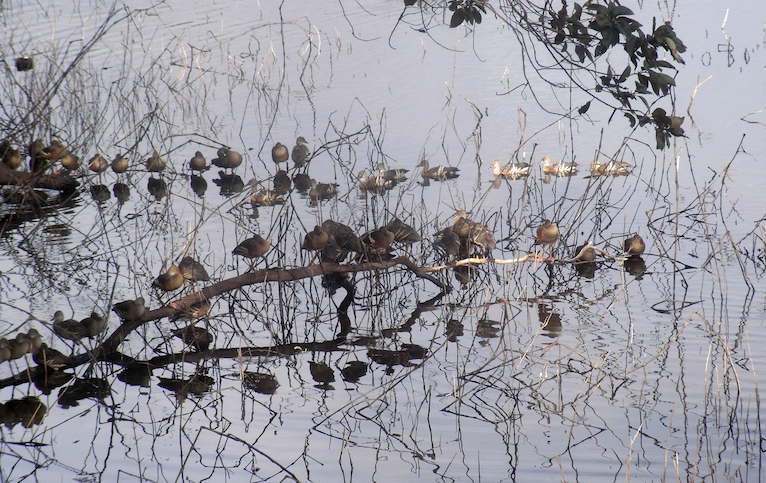 |
| Plumed Whistling Ducks at Hasties Swamp near Atherton |
A large majestic duck, mostly in pairs. A regular at the lagoon at Yorkey's Knob golf course, a pair also visited the grass along Yeppoon Rd between the Tanby and Scenic Hwy roundabouts.
 |
| Rajah Shelducks at Yorkeys Knob Golf Course |
Anyone who has visited northern QLD will be familiar with the call of the Curlew. It is a loud wailing call, which I was told the local indigenous people think very bad luck to imitate. They are a ground dwelling bird whose habitat has rapidly disappeared with our colonisation along the coastline. The first time I heard one was at Rollingstone Caravan Park north of Townsville. We were staying in a tent and were kept awake half the night wondering what on earth was being strangled! When we moved to Cairns we had one or two that liked our front garden, and they were a regular under the light near the stinger net at Palm Cove catching the insects that were attracted there.
 |
| Bush Stone Curlew, Wildlife Habitat, Port Douglas |
I am putting this lovely little bird in for it's song. In the early morning all along the north QLD coast you can hear this quite unassuming honeyeater twittering away. We had a pair nest in our Lillipilli hedge at Kewarra Beach, and although they are common and do not have particularly striking plumage
the cheerful way they greet the day and say goodnight was always welcome.
 |
| Brown Honeyeater (image source: Brown Honeyeater - Wikipedia) |
In contrast to the little Brown Honeyeater the Blue Face has found it's way into this list for it's striking blue skin found around it's eyes. They are quite a cheeky bird and inquisitive. They loved the palms around the Rollingstone Caravan Park, as well as the picnic area at Cape Hillsborough.
 |
| Blue Faced Honeyeater (image source: Blue Faced Honeyeater - Wikipedia) |
These fairly secretive birds are part of the Megapode family mega meaning big and pod meaning foot. As their name betrays they have orange legs and feet and use them to scratch around in the leaf litter for tasty things. There was always one or two in the scrub at Catana wetland, but they would appear in most areas that had decent forest and good moist leaf litter.
 |
| Orange Footed Scrub Fowl (image source: Orange-footed Scrubfowl - Wikipedia) |
Most Aussies along the East Coast would have seen one of these birds at one point or another. They are also a Megapode and construct large mounds for nests. We had one living in our back yard at Zilzie, but they are very opportunistic and turn up at picnic areas. The males have a striking bright red head and yellow wattle.
 |
| Brush Turkey strutting its stuff at Lake Eacham on the Atherton Tableland |
Butcher birds are related to Magpies and have a very melodious song. There were many living around Seaspray Resort in Zilzie and one often came and sat in our carport. They will respond if you whistle songs back to them. I also saw them in and around Blacks Beach Cove, particularly around the wetlands.
 |
| Pied Butcher bird in a Eucalypt at Seaspray Resort, Zilzie |
Quite hard to see when they are pretending to be a log. There was a resident Papuan Frogmouth near Saltwater creek in Cairns, and we saw many Tawny Frogmouths living at Zilzie. They would sit
under street lights and catch insects, one even took to sitting in our backyard or on the letter box!
 |
| Freddo the Tawny Frogmouth on our letter box in Zilzie |
Saturday, 7 July 2012
Photos from my recent escapades

Wattle against the blue sky, taken in Moreton National Park

Scribbles on a local Scribbly Gum, Penrose forest

Banksia spinulosa, taken in Penrose forest

Tree ferns at the bottom of one of the special swamps found in Penrose forest
I will write some more on these swamps down the track, as my Father runs the 'Penrose Swamp Group' through Landcare. They are special for a few reasons, one of which is because they contain a rare Eucalypt, Eucalyptus aquatica.
Colour and a trip to the rainforest
On Tuesday 3rd July I was lucky enough to have to opportunity to join the local Birdlife Southern Highlands group. We visited a private property in Robertson that has a large area of isolated rainforest. This trip was particularly appealing to me, having spent a bit of time exploring the rainforests of far north QLD. The owners had compiled a great list of birds they had sighted on the property, mostly from the kitchen window!


The tour started along the edge of the rainforest. The first birds of the day were thornbills that were flitting around in the canopy. Right at the very edge however, a small flock of white-browed scrub wrens were spotted. These caused a bit of controversy at the time as their breasts were quite an olive/yellowy-green (I will come back to this later). We moved up into the rainforest where someone had constructed excellent paths, well signposted, in a circular walk. The rainforest is growing in a substrate of chunks of angular basalt chunks and rich volcanic red soil (which is wonderful for growing things in, particularly the potatoes for which Robertson is famous). The owners had organised a botanist to come through and several plant species were labelled. The largest trees appeared to be a Lillipilli variety, Acmena smithii , which have beautiful magenta berries when in fruit. Many of the trees were host to ferny epiphytes, and mosses.


It was very cool under the canopy, but surprisingly moist for such a cool climate forest. As anyone knows who has tried bird watching in rainforest, it's dark. This is not good for spotting birds. However, one of the highly seasoned bird lovers spotted something dashing across the leaf litter and exclaimed 'a Bassian thrush!' Binoculars were hastily raised and confirmation of the sighting occurred in a split second. Bassian thrush are quite hard to see, and considering it is brown and speckled it is a miracle that it was seen at all in the dimly lit forest. The other lovely thing of note was a bower. It belongs to the Satin bower bird. Related to cat birds, bower birds are all a striking greeny olive, until at around 7 years the males turn a dark satiny blue, hence their name. We have one living in the garden, called Boris. They tend to raid vege gardens and are particularly fond of leafy vegetables. Bowers are constructed as a display area for the males to entice a mate. They decorate them with blue objects such as milk bottle tops, pegs, straws, and blue flowers. Rival males will destroy each other's bowers and steal items from them.

The small pile of twigs on the left is what is left of the bower structure.
We emerged from the rainforest after stopping part way to admire a spectacular view down to pigeon house mountain. Down into the garden and past some gorgeous donkeys in their thick, fluffy, winter coats, past the gorgeous roly poly sheep and pair of alpaca. We retired to the veranda for refreshments after spotting some red browed finch in some camellias. This is when the bird watching really took off! As if on cue a flock of superb fairy wrens zipped into one of the hedges, watched over by a Laughing kookaburra an Eastern yellow robin, Crimson rosellas, and a possible Flame robin!
Over tea the owners spoke of their plans to further extend the rainforest in the future with a view to connect a corridor down into the valley. It would be a massive undertaking, but one well worth the effort in my opinion.
The sun was starting to dip down as we thanked our hosts and headed back to our cars before the temperature dropped too far. Although we didn't see a billion birds, what we did see was well worth it, especially with the walk through the rainforest.
On arriving back in Bundanoon I did a bit of research into the White browed scrub wren. All the images I could find were quite light on the breast, not the rich olive yellow of the ones spotted in Robertson. All but one image I found via Google, which interestingly had been taken in Robertson and put on this blog. So it would seem there may be a colour morph for this species, isolated to Robertson. A nice discovery if it turns out to be correct!
This revelation got me thinking. If birds can have different colours depending on their location, did Dinosaurs? Maybe one day we will be able to find this out.
Thursday, 5 July 2012
So how can you tell the colour of a dinosaur?
One of the many controversies surrounding Dinosaurs is how we can possibly know what colour they were. Recently, research on a turkey sized carnivorous dinosaur Sinosauropteryx, found in China, revealed the presence of melanosomes. A melanosome is specialised subunit (organelle) within a cell that contains melanin which is the most common light-absorbing pigment found in the animal kingdom. The melanosomes were found in the fossilised feathers or 'dino-fluff' which can be seen on the excellent fossil of Sinosauropteryx, illustrated below.

.jpg)

Looking at the tail and along the spine of Sinosauropteryx the darker 'fluff' is quite visible. Study of this feathery fluff indicated that it was most likely a red or rufous colour. For a paleoartistic perspective on Sinosauropteryx check out this National Geographic article. So Sinosauropteryx had a striped tail, and a ridge of rufous downy feathers along its spine! Work is now being done to find melanosomes in other specimens, to give a much more colourful understanding of dinosaurs.
I should also add that in my previous post I put forward that Archaeopteryx was not much of a flier, but more similar to a gliding mammal. Further reading today shows that the information I based this on is now out of date. It is now thought that Archaeopteryx was actually very capable of flight, much the same as a modern bird. To make up for this I give you a spectacular image of a fossil Archaeopteryx which is from the Berlin Museum for Nature.
.jpg)
Subscribe to:
Posts (Atom)